

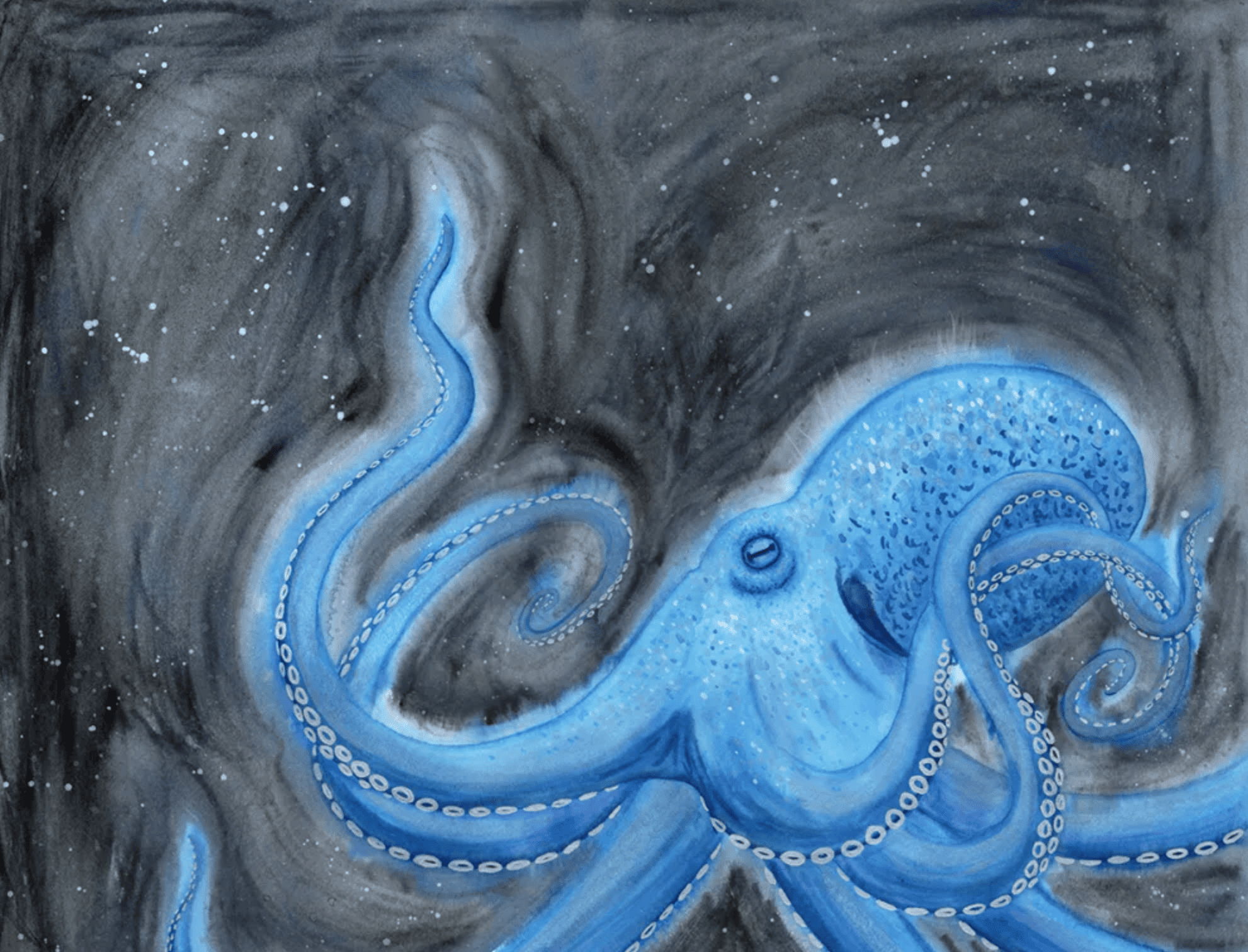
“kirameki i” ©nicole hanusek art
What happens to us when we stop caring whether something was made with intent, with experience, with a point of view that belongs to a specific person who lived a specific life and chose to put something into the world because of it?
That question touches everything: how we understand history, assign value to human labor, or who gets displaced when machines produce “good enough” at scale. I worry about what happens to our capacity for wonder when the things that used to stop us in our tracks become indistinguishable from their algorithmically generated copies.
We are a design agency and everything we build is a creative act. Every creative act carries the fingerprints of the people who made it including the judgment calls, weird instincts, and the understanding of an audience that only comes from paying close attention over a long period of time. We care about this because we believe that process is where the value actually lives.
Here is why this matters to us, and why we think it should matter to you.
Art has always been how we (as humans) understand each other.
Art history is a record of what people thought, felt, believed, and imagined across every culture and era of human civilization. Smarthistory [1], one of the most widely used art history resources in the world, frames it this way: art allows us to see through the eyes of others, so we see the world as we have never seen it before. That capacity matters because simply looking at something made by another person and understanding their experience through it is foundational to empathy and cultural literacy. It shapes how we make sense of who we are in relation to everyone who came before us and helps us leave something behind that the next generation can learn from.
Art historians Sonja Drimmer and Christopher Nygren, writing in the International Journal for Digital Art History [2], proposed ten axioms for the relationship between AI and art history. Their first axiom is worth sitting with: the history of art is not a problem to be solved. AI is built to find solutions. Art does not pose questions with correct answers. It poses questions that shift depending on who is looking, when, and from where. The ambiguity is the point.
When we flatten art into content, when we treat creative output as a production problem that AI can optimize, we lose so much more than the object. We lose the reason the object existed in the first place.
Contrary to what we’re being trained to believe, it matters whether something is real.

©marianne butler art, drishti design
Research consistently shows that people respond differently to creative work when they know AI generated it. Viewers rate AI-generated artwork as less meaningful, less creative, and less worth their attention, regardless of visual quality. Something about knowing the origin changes the experience entirely.
The flip side is much harder for me to accept. When people cannot tell the difference, they often rate AI-generated work just as highly as human-made work. Sometimes higher. That is not a reassuring finding. It means the capacity to distinguish between something made with intent and something assembled from patterns is already eroding. Once that distinction disappears, so does the framework we use to value human creative labor.
A photograph of a war zone taken by a journalist who risked their life to be there carries a weight that a photorealistic AI rendering of the same scene never will, even if the two images are pixel-for-pixel identical. The origin carries the meaning.
Duke University’s AI Ethics Learning Toolkit puts this bluntly: AI models are trained on vast amounts of human-generated content scraped from the internet, often without permission, credit, or compensation [6]. Wildlife photographer Tim Flach, one of the most scraped artists in the world, described the practice as “parasitic”. The content that trains these systems was made by people who spent years developing their craft. The output that replaces them was built on their work without their consent.
When we lose the ability to tell the difference between the original and the imitation, we devalue the copy, the original and the creator along with it.
Sameness is a form of displacement.
When AI generates creative work, it draws from patterns in its training data. The output converges toward the center: common compositions, familiar phrases, statistically probable arrangements. The result is average and, at scale, fills the world with work that looks and sounds and feels interchangeable.
Drimmer and Nygren identified this dynamic in their research: AI relies on scale, and thereby necessarily privileges objects and data that are already categorized and available. It reinforces existing hierarchies rather than challenging them. Whatever was overrepresented in the training data becomes overrepresented in the output. Perspectives that were already on the margins get pushed further out.
This goes beyond aesthetics. Counterculture LLP’s analysis of AI’s impact on the creative industries in the UK found that AI-generated content is already displacing human creative professionals, particularly in commercial and freelance sectors [3]. The people most affected are not the established names at the top of the industry. They are working artists and emerging voices building careers in the space between amateur and famous. That middle is hollowing out.
Wharton visiting scholar Cornelia Walther’s research on AI and exclusion puts the stakes in broader terms: AI can deepen digital poverty and widen existing inequities when leaders fail to build inclusive systems [4]. Communities with the least representation in training data are the ones most likely to be erased by the output, and the ones with the least economic cushion are the least able to compete with tools that produce work at near-zero cost. The sameness AI creates weighs heaviest on the people who were already fighting to be seen.
Wonder requires something to wonder at.
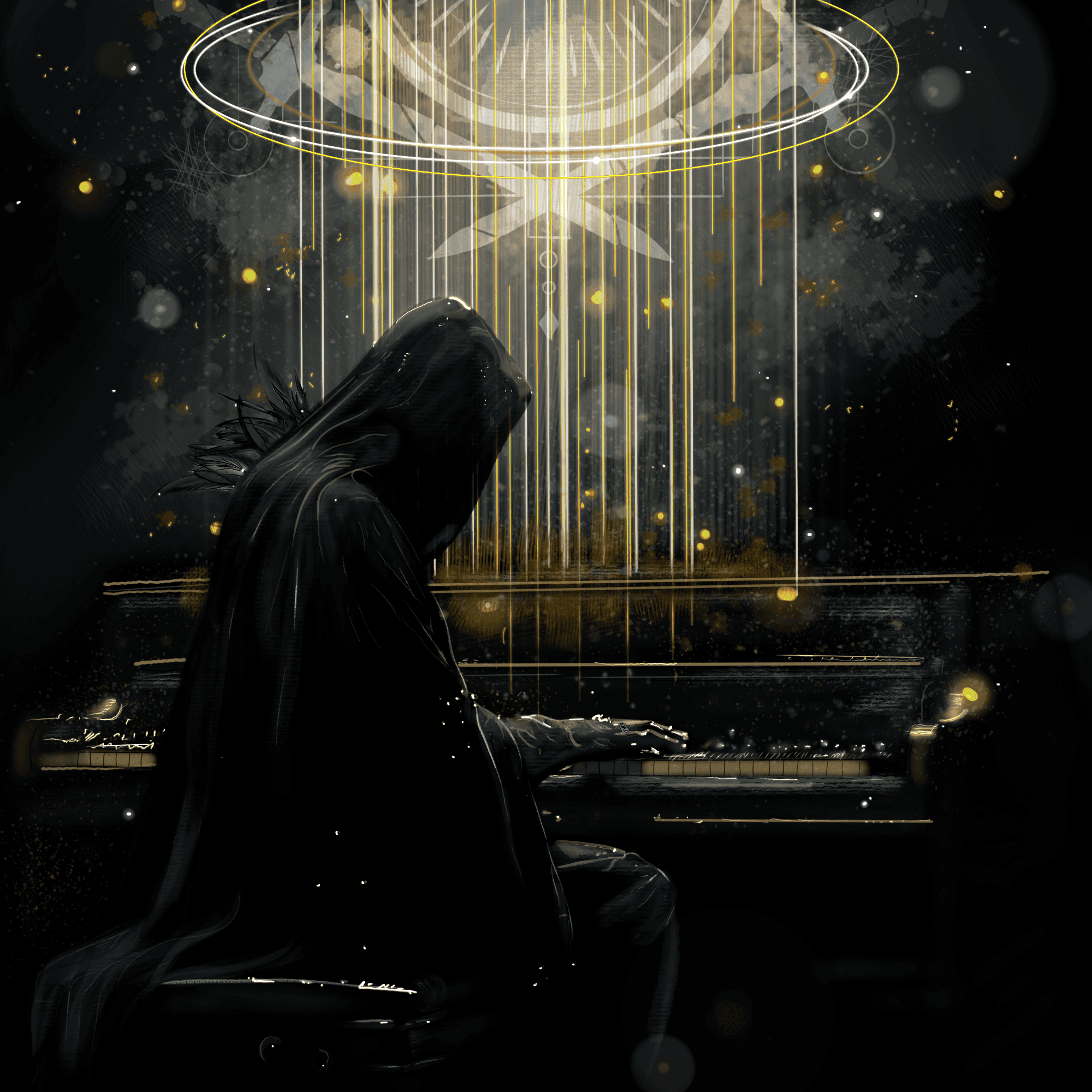
“damocles” ©danielle iera art, sleepy worship
In 2017, Ryan Bell wrote a piece for The Humanist magazine called “How Poverty Kills Wonder and What We Can Do About It.” The article draws on the work of psychologists Abraham Maslow, Eldar Shafir, and Sendhil Mullainathan to argue that wonder is not a luxury. [5] The experience of being stopped in your tracks by something that exceeds your capacity to process it is a fundamental part of human flourishing and it depends on conditions that make it possible.
Shafir and Mullainathan’s research showed that scarcity imposes a measurable tax on cognitive bandwidth. When people are consumed by survival, by financial stress, by the logistics of getting through the day, their minds narrow. The capacity for awe gets crowded out and bandwidth is already spoken for.
What scares me the most? That research was about economic poverty. When the world is filled with generated content that is competent but empty or when every surface looks polished but nothing behind it was made with intent, the opportunities for genuine wonder get thinner and thinner. There is simply less to be surprised by and wonder depends on surprise.
Encountering something that could not have been predicted by an algorithm because it came from a person who made a choice no statistical model would have landed on. Ever seen a color combination that breaks the rules yet somehow it works? Have you read a passage that catches you so off guard you make a note of it? Can you recall noticing something that made you feel emotional before you understand why? Those moments come from human judgment applied with care and specificity.
While pattern-matching at scale may not eliminate wonder entirely, it slingshots the act of wonder further and further from our reach. Generations that grow up surrounded by generated content may never know what they are missing and that is the most depressing outcome of all.
The risky narrative is that art does not require a maker.
There is something so dark about the belief that art does not need a source. The “removal of the maker” promotes a dangerous notion that the value of creative work lives entirely in the output, with no connection to the person, the process, or the intent that produced it.
That belief rewires the act of appreciation itself. When we stop asking “who made this and why,” we stop engaging with art as a human act and start engaging with it as (solely) a product to be consumed. The distance between those two modes of engagement is the distance between a culture that values creative work and one that treats it only as a commodity.
The Counterculture LLP report on AI threats to the arts documents what this looks like in practice: AI-generated deepfakes and synthetic media can mimic voices, faces, and performances well enough to create convincing but fraudulent representations of artists without permission [3]. The integrity of original performances erodes and any control artists have over their own creative identity slips away. Eventually, the economic foundation that supports creative careers collapses, not because the work got worse, but because “good enough” became free.
Drimmer and Nygren’s fifth axiom cuts to the core: it is important to know the difference between what humans do well and what computers do well. For computers, nothing matters except finding a solution. AI will always produce an output. If the input is distorted or incomplete, the output reflects that, but the machine is indifferent. It has no stakes in the outcome, no values shaping its decisions, and no instinct to push back on a brief that is heading somewhere wrong.
Human creativity may not be efficient and can be pretty inconvenient, but it is the only form of creative work that carries meaning, and meaning requires a consciousness that intended it.
Where we set our boundaries:
We use AI sometimes. It has helped us research faster, draft ideas, work through problems, and move more efficiently through parts of the process where speed adds value without sacrificing quality.
When it comes to art and creativity, the line is thick.
We do not use AI to replace the creative decisions that make any design feel like it belongs to the specific business it was built for. We do not use AI to generate the visual identity, the voice, the design direction, or the strategic choices that give a design its character. Those decisions come from people: designers, writers, and strategists who understand the client, the audience, and the difference between what looks right and what works.
We draw this line because we understand what gets lost when creative work becomes a production line. We have watched this industry long enough to know that the things that make a design genuinely effective come from people who care about the outcome and have the experience to act on that care.
Art is not content and design is not decoration. The people who create these things of wonder bring something to the work that no tool replicates, and we plan on defending that position for as long as we are in this business.
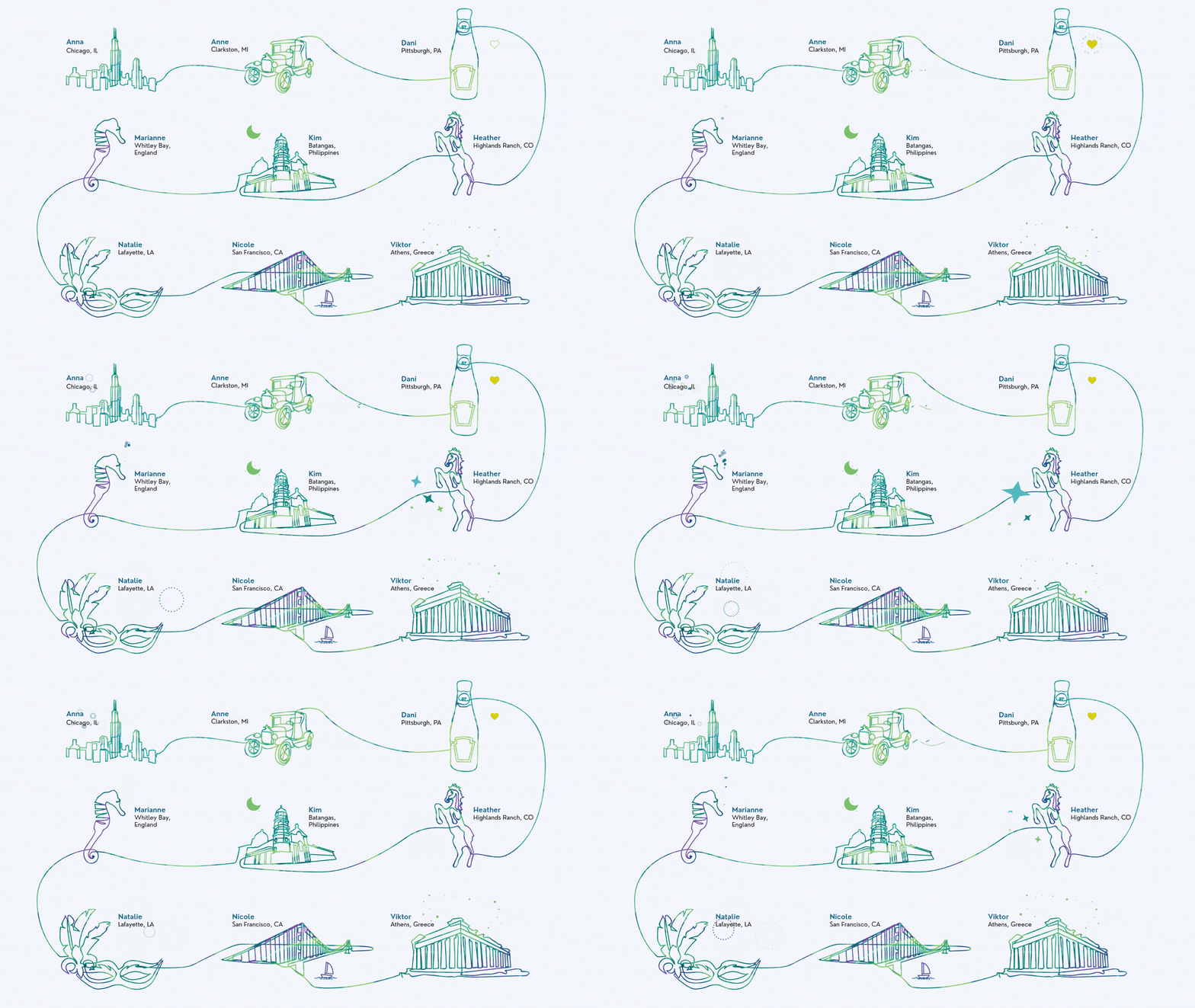
©smack happy design illustration by anna byun, dragonfly studio
Sources
- Dr. Robert Glass, “What is art history and where is it going?,” Smarthistory, October 28, 2017. smarthistory.org
- Sonja Drimmer and Christopher J. Nygren, “Art History and AI: Ten Axioms,” International Journal for Digital Art History, No. 9, April 2023. Summarized by Historica.org.
- “The AI Threat to the Arts,” Counterculture LLP. counterculturellp.com
- Dr. Cornelia C. Walther, “How AI Exclusion Impacts Humankind,” Knowledge at Wharton, January 28, 2025. knowledge.wharton.upenn.edu
- Ryan Bell, “How Poverty Kills Wonder and What We Can Do About It,” The Humanist, September/October 2017. thehumanist.com
- “Is AI Theft? Exploring Copyright and Intellectual Property,” Duke University Center for Teaching and Learning, AI Ethics Learning Toolkit. ctl.duke.edu
Art Credits
- Smack Happy Design Illustration by Anna Byun, Dragonfly Studio
- “Damocles” Danielle V. Iera, Sleepy Worship
- Marianne Butler, Drishti Design
- “Kirameki I” Nicole Hanusek, Nicole Hanusek Art

